Improvement of Reinforced Concrete Crack Analysis in LUSAS V22
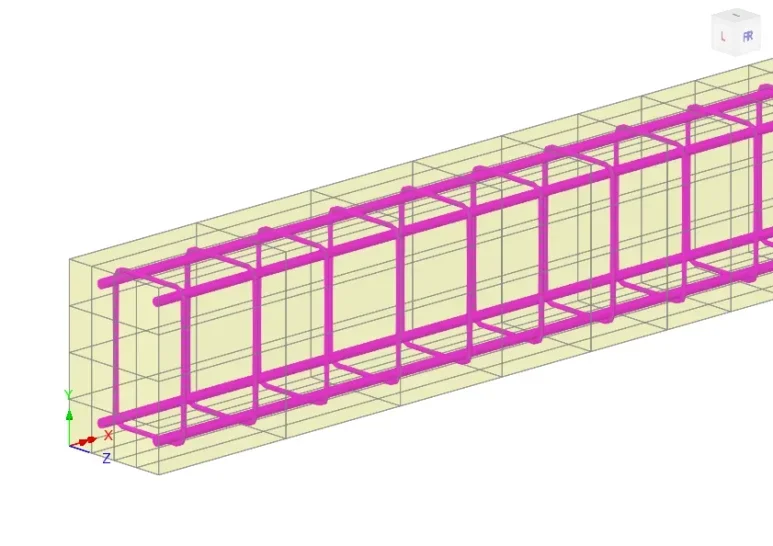
The modeling method for reinforced concrete crack analysis has been improved. Let’s examine how it has changed by comparing the nonlinear concrete examples from the existing V21 and V22.
Comparison Summary
| Category | V21 | V22 |
|---|---|---|
| Rebar Definition Method | Configured as an object that can share nodes with concrete | Configured as a separate independent object from concrete |
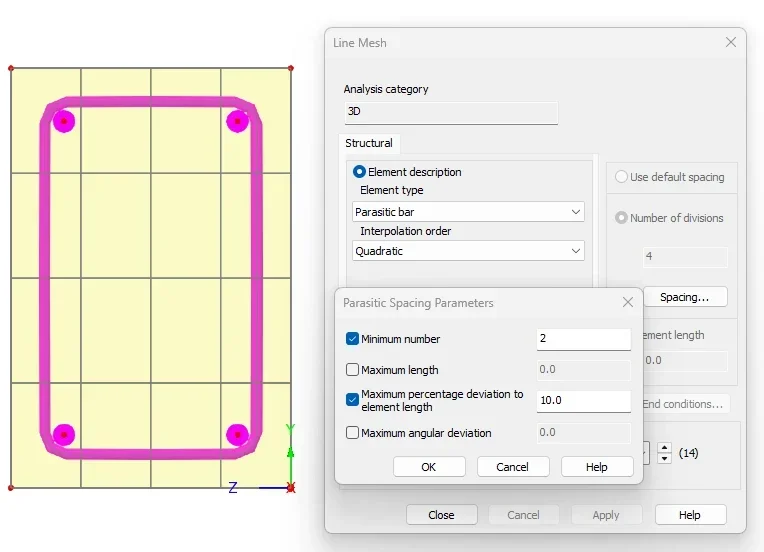
| Rebar Element Definition | Must specify the number of divisions for rebar elements according to the division number of concrete elements | Automatically specified based on the number of divisions of concrete elements (using Parasitic Bar elements) |
| Modeling Efficiency | Inconvenience exists in dividing the structure into multiple lines, surfaces, etc., considering node connections | By clearly separating the two objects for drafting, it minimizes engineer errors. Maintaining and modifying the model is significantly easier |
Rebar Definition Method
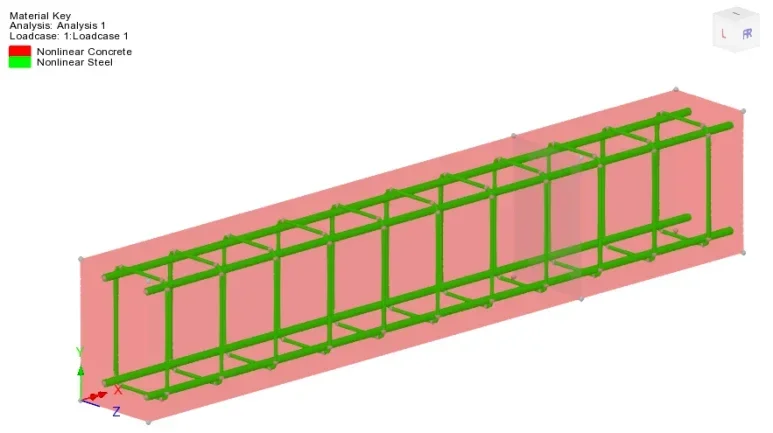
In V21, the rebar was configured by splitting the concrete at the location of the rebar, allowing both to share nodes. When the structure became a bit complex, connecting the nodes of rebar and concrete was challenging.
Improvements in V22
In V22, rebar is modeled as a separate object from concrete. There is no longer a need to split concrete at the location of rebar; each structure can now be modeled individually. This makes understanding the structure visually and structurally easier.
Rebar Element Definition
In V21, it was necessary to manually specify the number of divisions for rebar elements according to the number of divisions of concrete elements. In V22, the number of divisions for rebar elements is automatically specified based on the number of divisions of concrete elements. This minimizes potential errors that could arise from manually specifying and applying element divisions, and reduces modeling time.
Modeling Efficiency
In V22, the analysis model can be composed more conveniently, making maintenance and modification tasks much easier. The time spent on modeling has decreased, resulting in an overall improvement in work efficiency.
For more details, please refer to the attached Reinforced Concrete Beam Crack Analysis example manual.
Download Reinforced Concrete Beam Crack Analysis.pdf file